 By
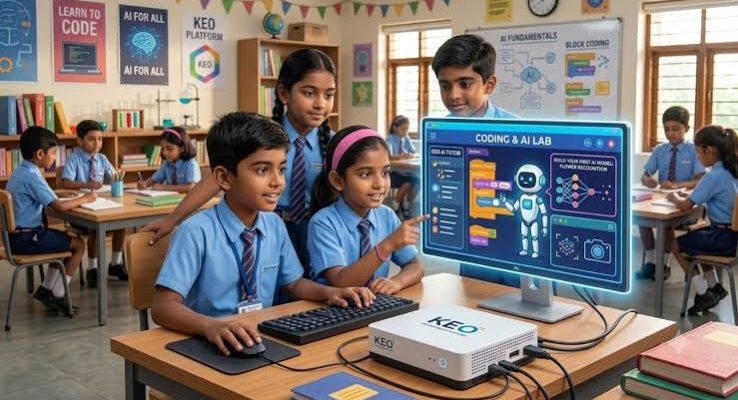
By Starting with the 2026–27 academic year, artificial intelligence will formally enter Karnataka’s government classrooms — not as an elective add-on, but as a full vocational subject for Class 9 and 10 students, replacing the third-language option under the state’s skill-education framework. The scale is significant: 1,642 government high schools will offer the course, making it one of the largest state-led AI education rollouts in the country. But as the program moves from paper to classroom, questions about feasibility — language, staffing, and readiness — have followed close behind.
What’s Actually Being Rolled Out
The initiative is being implemented through Samagra Shikshana Karnataka (SSK), the state’s flagship school education program, after clearance from the Project Approval Board. The AI course is aligned with the National Skills Qualifications Framework (NSQF), positioning it alongside existing vocational streams like Beauty & Wellness or Retail rather than as a standalone academic subject.
The 1,642 participating schools fall into three categories: 1,180 newly approved high schools, 381 existing NSQF schools, and 81 single-sector schools where AI will replace older vocational offerings. Under the existing rules, a student who opts for a vocational subject in Classes 9 and 10 is exempted from studying a third language — meaning AI is effectively being offered as an alternative pathway to Hindi, Kannada, or whichever third language a school currently teaches. Officials have also signaled that students who take up AI at the secondary level can continue it through NSQF-aligned courses at the Pre-University stage.
The Staffing Plan — and Its Gaps
To get the program running by next academic year, SSK has directed every participating school to appoint one AI guest teacher, selected by a committee headed by the School Development and Monitoring Committee (SDMC). Reported eligibility criteria include a BCA or BSc in Computer Science or IT, and selected guest teachers will be paid an honorarium of ₹20,000 a month.
That framework is exactly where the feasibility questions begin. Government schools recruiting one guest teacher per school, on a modest monthly honorarium, to teach a genuinely emerging and fast-changing technical subject is a very different proposition from a well-resourced private school building an AI lab with permanent staff. Whether enough qualified candidates — particularly in rural and semi-urban Karnataka — are willing to take up a guest-teaching role at that pay scale is an open question the rollout will have to answer in real time.
The Language Flashpoint
The more politically charged concern is what AI’s arrival means for the state’s existing language teachers. Because AI is being offered as a substitute for the third-language slot, it lands squarely inside a debate that was already running hot in Karnataka: the state’s three-language formula, and the place of Hindi within it, has been a recurring source of friction between the state government, language teacher bodies, and political parties for the past couple of years — from disputes over grading third-language papers in the SSLC exam to protests demanding a shift toward a two-language model.
Language-teacher associations have raised concerns that a recruitment framework tied to the AI rollout could, in effect, narrow future hiring for high-school language teachers to just Kannada and English — leaving Hindi and other third-language teachers uncertain about long-term job security, even though the current third-language stream continues in lower classes and non-NSQF schools. The issue has already reached the state’s Legislative Council, where members across party lines have sought a discussion on the concerns, though it wasn’t taken up during the September session. Teacher groups have submitted formal representations to the state government asking it to reconsider or clarify the policy.
Part of a Bigger National Shift
Karnataka’s move doesn’t exist in isolation. CBSE has offered AI as a skill subject at the secondary level since 2019, and enrolment has grown steadily — over 7.9 lakh students across more than 4,500 CBSE schools opted for it in the 2024–25 session alone. At the national level, the Union education ministry has also been working on an AI and Computational Thinking curriculum intended to start as early as Class 3, developed through CBSE, NCERT, and state consultations.
What makes Karnataka’s version distinct is its framing and its reach into the government-school system specifically. Rather than treating AI as an optional add-on subject, the state has folded it into its vocational education architecture — the same structure used for hands-on trade skills — and applied it at a scale (1,642 schools in the very first phase) that few other states have attempted for a government-school AI program.
The Real Test Is Inside the Classroom
Policy documents and school counts only tell part of the story. Whether this initiative succeeds will depend on things that don’t show up in an approval order: whether guest teachers are actually recruited and retained at the offered honorarium, whether schools without reliable computer labs or internet access can deliver a meaningful AI curriculum, and whether the language-teacher standoff is resolved in a way that doesn’t leave either side worse off.
Karnataka is betting that introducing AI early — even through a modest vocational framework — gives government-school students a foothold in a skill set that will only grow more central to future employability. The ambition is not in question. Whether the state has the teaching capacity, infrastructure, and political consensus to match that ambition is what the 2026–27 rollout will actually test.