
 By hodo_admin
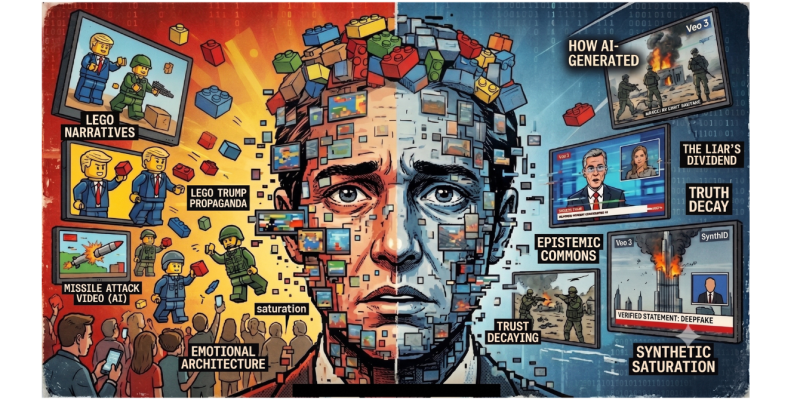
On March 10, 2026, ten days into the US-Israeli bombing campaign against Iran, Iranian state media broadcast a video called “Narrative of Victory.” It opened with a panicking Lego Donald Trump leafing through a folder marked “Epstein File,” urged on by a cackling Lego Benjamin Netanyahu and, for good measure, a Lego Satan. Incensed, Trump pushes a big red button. A US missile strikes a girls’ school. A tearful Iranian soldier cradles a child’s pink backpack left in the rubble, an unmistakable reference to the Shajareh Tayyebeh elementary school in Minab, where 175 schoolgirls and staff were killed on the first day of the war. The video ended with a distraught Trump watching a parade of flag-draped American caskets march past while an AI-generated rap track played him out. Lego figurines, plastic rubble, generated audio. This accumulated billions of views.
Welcome to slopaganda. A portmanteau of AI slop and propaganda, the term was coined by Michał Klincewicz, a computational cognitive scientist at Tilburg University, together with Mark Alfano and independent media researcher Amir Fard, in a 2025 paper published in Filosofiska Notiser. Since late February 2026, pro-Iranian media groups, most notably the X account Explosive Media, which admitted to the BBC that the Iranian government is a client, have flooded social media with this content. Trump has appeared as a Teletubby in an American flag-themed outfit, playing with toy fighter jets over a map of the Middle East. Iranian soldiers have been rendered avenging Lego warriors, launching missiles at blocky Orthodox Jewish men and Saudi sheikhs scrambling across the Gulf.
Yet your government has no coherent answer to this. And if the instinct is to dismiss a few plastic Lego figures as too ludicrous to constitute a genuine threat, that instinct is precisely what slopaganda is designed to exploit. The weapon was always the assumption that content this nonsensical couldn’t possibly be one.
The three most viral false AI-generated videos under The Iranian Lego campaign identified by BBC Verify during the conflict garnered over 100 million views. These numbers act as measures of something tough to quantify: the cumulative emotional residue left by content that most viewers clocked as fake and watched anyway, for reasons entirely their own. The goal was saturation, and saturation was achieved.
Presence > Persuasion
Classical propaganda at least had the decency to try to convince you of something. It was painstaking, expensive, and centrally controlled, built on the premise that your belief was worth pursuing. These videos are effective because they are emotionally arresting, engineered to build associations, designed to saturate feeds until those associations calcify deep in the penumbra of a viewer’s subconscious, regardless of what they consciously believe. If enough synthetic content floods an information environment, the distinction between real and fabricated grows immaterial, and that ambient uncertainty then becomes the weapon. Nancy Snow, a propaganda scholar, described the Iranian campaign as “using popular culture against the number one pop culture country, the United States.” The Lego videos construct an emotional architecture of Trump as buffoon, America as aggressor, Iran as wronged, built at scale, for nearly nothing, faster than any rebuttal can follow.
The Well Is Poisoned
The downstream damage has two names. Legal scholars call the first “truth decay”: a media landscape where AI-driven fabrications erode epistemic trust to the point where any footage can be dismissed as synthetic. This is, of course, enormously useful to anyone who has done something they would rather the public not verify.
The second is the “liar’s dividend,” coined by Bobby Chesney and Danielle Citron — the secondary bounty of a world awash in synthetic content. Simply put, the more fabrications that exist, the cheaper real accountability becomes, as bad actors are granted plausible deniability as a byproduct of the sheer proliferation of deepfakes. During the Iran war, audiences began mistakenly identifying genuine footage, including a verified statement from Netanyahu, as evanescent noise in a feed full of fakes. Saying “it could be a deepfake” costs nothing. Proving that content is authentic requires forensic analysis, metadata examination, and technical consulting, and even then the result is probabilistic. Slopaganda is aware of, and actively exploits, this structural asymmetry with something close to fidelity.
The First Tiktok War
If the First Gulf War gave the world live television combat, the 2026 conflict gave it something altogether more challenging: the first large-scale confrontation in which generative AI played an active, intentional role in the information theatre alongside the kinetic one. Among the fabrications circulating during the conflict:
- GetReal Security linked fabricated war videos directly to Google’s Veo 3 generator. The Tehran Times posted a video claiming to show an Iranian missile striking Tel Aviv, Veo 3’s watermark visible at the bottom of the frame.
- AI-generated images of Dubai’s Burj Khalifa on fire, marked with Google AI’s SynthID watermark, spread before any correction appeared.
- Synthetic nighttime missile strike videos, almost indistinguishable from real footage under casual scrutiny, circulated with no labels.
GetReal’s co-founder Hany Farid called this potentially “the first instance where generative AI is extensively utilised during a conflict” at this scale. Insikt Group tracked multiple Iranian influence networks, including Storm-2035, previously active in the 2024 US elections, pivoting to the conflict within hours of the first strikes.
India Already Knows This
The Iran war made slopaganda globally visible. But India has already lived through a subtler version of the same thing and has not fully reckoned with what it portends. During Operation Sindoor in May 2025, the information environment fractured almost immediately:
- Deepfakes of Prime Minister Modi, Home Minister Amit Shah, and External Affairs Minister S. Jaishankar purportedly admitting defeat, confirmed fabricated by FACTLY, BOOM, and PIB Fact Check.
- An AI-generated photograph of a supposedly bombed Rawalpindi stadium accumulated over 9.6 million views on X without a label or fact-check.
- A political candidate alleged an audio clip in which he criticised his own party was a deepfake, even after fact-checkers confirmed it was authentic. The technology handed him a denial, and the denial was sufficient.
The structural vulnerability India faces outpaces most comparable democracies. Twenty-two official languages means that verification systems must operate across linguistic registers where most automated detection tools have thin or negligible coverage. The 2027 Uttar Pradesh assembly elections will unfold across a state of 240 million people, with deep caste and religious stratification, in an information environment where fabricated content reaches rural constituencies faster than any fact-checker is able to follow. The infrastructure for this already existed before Operation Sindoor, and was put to the test during it.
What Governance Requires
Platforms are losing this war comprehensively. It is an arithmetic dysfunction: one person with a free-tier AI account can generate hundreds of videos per day, but removing them requires human judgment at every step:
- Community Notes face chronic delays. By the time a correction appears, the content has completed its primary viral cycle.
- Meta reported a 50% reduction in enforcement mistakes in early 2025. The Centre for Countering Digital Hate estimated the same policy changes could mean 97% less enforcement in areas including hate speech.
- In December 2025, X was fined €120 million by the EU for violating the Digital Services Act. On a platform generating billions in revenue, €120 million is no more than an operating cost.
Every existing framework treats slopaganda as a content problem: flag it, remove it, label it. The content arrives faster than any removal system can function, and the emotional damage is front-loaded. What is almost entirely absent is any reckoning with the production side: whether general-purpose AI tools capable of mass synthetic media generation should face the same export controls and liability frameworks as other dual-use technologies. Google’s Veo 3 is a commercially available, consumer-grade tool that produced footage shared as a fabricated act of war. That gaping chasm between that capability and the governance is certainly not a technical inevitability, so it is an active choice, and a political one.
What Comes Next?
Europol has projected that 90% of online content could be synthetically generated by 2026. A population that cannot reliably distinguish real from fabricated becomes epistemically exhausted, retreating into tribal heuristics, deciding authenticity is a secondary concern. Slopaganda erodes the conditions under which shared political paradigms can be constructed at all.
For now, slopaganda is still relatively legible. The Lego videos are transparently artificial. The deepfakes of Modi carry distorted lip movements. The Veo 3 watermarks are occasionally visible. But the gap is closing. The eight-second Veo 3 tells that Farid identified as a diagnostic will disappear into longer, more seamless outputs, and the perceptible distance between fabrication and truth is narrowing toward zero.
What slopaganda puts at risk is the epistemic commons, the mutual informational environment in which democratic participation, collective sense-making, and civic trust are possible at all.
Defending that commons would require synthetic content to carry verifiable provenance, platforms to bear genuine liability for viral fabrications, and governments to build verification infrastructure with the same seriousness they bring to military capacity. That requires political will that has not materialised anywhere at sufficient scale.
Until it does, the most consequential theatre of modern conflict is in the feed. And the feed is, right now, winning.