
 By hodo_admin
The Heat Island Effect
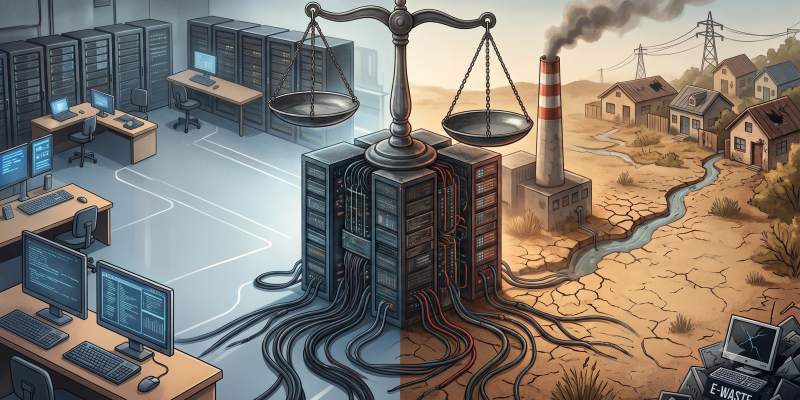
When you asked ChatGPT a question this morning, a GPU cluster in Northern Virginia, or outside Dublin, or on the outskirts of Singapore, ran at full power to answer it, expelling heat into the surrounding air and drawing water from a local supply to cool down. This exchange happens millions of times a day, and the surrounding communities absorb consequences that rarely make it into the discourse about AI’s environmental cost.
A 2026 study by researchers at Cambridge and Nanyang Technological University put a number on one of those consequences. Land surface temperatures around AI data centres rise by an average of 2°C after operations begin, with some sites recording increases as high as 9.1°C. The researchers called this the “data heat island effect,” a localised warming pattern detectable up to 10 kilometres from a facility. More than 340 million people live within that radius globally.
This is separate from carbon emissions, which dominate most environmental coverage of AI. The heat island effect is a different problem: physical, local, and largely absent from the policy conversation.
Energy, Water, Land: The Numbers
Data centres consumed an estimated 448 terawatt-hours of electricity in 2025, more than Saudi Arabia. By 2030, that figure is projected to reach 945 TWh. Capital expenditure for data centre facilities is predicted to reach $760 billion in 2026, up from $450 billion the year before. Google’s parent company alone is planning to invest $185 billion into AI infrastructure this year, spending that exceeds the GDP of entire countries.
By 2030, the water footprint of global AI data centres will equal the basic annual domestic water needs of all 1.3 billion people in Sub-Saharan Africa, and their land footprint will exceed 14,500 square kilometres, roughly twice the Jakarta metropolitan area.
A single 100-megawatt hyperscale facility consumes around 2 million litres of water per day, equivalent to the daily needs of roughly 6,500 households.
Which Communities Bear the Cost / The Communities Bearing the Cost
The environmental cost of AI infrastructure pools in specific places, and those places tend to be impacted by it in ways the global aggregate obscures.
In Ireland, data centres exceeded the electricity consumption of all urban households combined by 2023, prompting the national grid operator to pause new approvals around Dublin until 2028. In Querétaro, Mexico, plans for fast-tracked data centres stand to jeopardise water supplies amid prolonged droughts.
The pattern inside the US is more specific still. The NAACP sued Elon Musk’s xAI in April 2026 over its use of methane gas turbines to power a data centre in a suburb of Memphis. Abre’ Conner, director of the NAACP’s Center for Environment and Climate Justice, noted that facilities were being sited in communities with significant Black populations and existing industrial footprints, places like Bessemer, Alabama and Clarksdale, Mississippi, communities she says share two characteristics: a history of disinvestment and a significant Black population. In Tucson, Arizona, local officials were required to sign non-disclosure agreements before residents were told a data centre was being proposed in their community.
A Gallup poll from early 2026 found 7 in 10 Americans opposed data centre construction in their communities. Between March and June 2025, that opposition translated into $64 billion worth of data centre projects being terminated through community organising.
Erin Brockovich Has Seen This Before
Julia Roberts won an Oscar playing her in 2001. Twenty-five years later, Erin Brockovich is now back doing the same thing she did in Hinkley, California, reading her inbox and seeing a pattern form.
In early 2026, Brockovich woke to find 30 emails from people in the same town, all raising concerns about a data centre. The volume kept coming. She launched a community reporting map in April; within a month, 3,862 residents had submitted reports across 49 states.
The single most common concern, she wrote, was not noise, not water, not electricity bills. It was one word: transparency. “Projects announced after permits are already secured, developers who don’t return calls, local officials who signed NDAs before their neighbours knew a project was being considered.”
Brockovich is explicit that she is not against data centres or AI. She is against the pattern she sees forming. “If data centres are so great,” she wrote on her Substack, “why are they being built in secret?”
The comparison to Hinkley is not incidental either. In both cases, the mechanism is the same: industrial infrastructure sited quickly, with minimal public input, in communities that lack the resources or political weight to push back, producing consequences that take years to surface and longer to litigate, and the choice to site these facilities in communities least equipped to fight back. The scale might be different, but this dynamic repeats itself.
Why Carbon Metrics Miss the Point
Most environmental assessments of AI focus on carbon emissions from model training. A UN University report published in June 2026 argues this framing misses a substantial part of the picture. Electricity carries a water footprint. Infrastructure carries a land footprint. These do not move in the same direction, reducing one can magnify another, and current disclosure frameworks rarely capture all three together.
The water trajectory alone is severe enough that researchers have begun comparing projected data centre consumption to the needs of entire continental populations
The efficiency argument, that newer chips do more per watt, holds up in isolation. It does not hold up against volume. As models get cheaper to run, more queries get processed. Gains in efficiency get absorbed by growth in demand. Without resource budgets or consumption guardrails built into AI governance frameworks, the trajectory stays the same.
The Build Out Continues
The data centre building boom is not pausing. Goldman Sachs projects a combined $5.3 trillion in capital expenditure from the four largest hyperscalers between 2025 and 2030. Nearly 1,500 facilities are currently in development across the US alone. In May 2026, Utah approved a single centre twice the size of Manhattan.
The most inventive response to the resource problem so far arrived in June 2026, when China switched on the world’s first underwater data centre powered by offshore wind, located 10 metres below the surface off the coast of Shanghai. The facility uses seawater for cooling, eliminating freshwater use entirely, and cuts land use by more than 90% compared to land-based facilities. It reduces electricity consumption by 22.8%. At 24 megawatts, it is a proof of concept. The gigawatt-scale facilities being built elsewhere to support AI demand dwarf it by a factor of forty.
The heat island study is the first to put satellite data behind what communities near these facilities have been reporting anecdotally for years. Brockovich’s map is the first to aggregate those reports at national scale.
The question for policymakers, particularly in countries now racing to build sovereign AI capacity, is whether environmental accountability gets designed into the infrastructure from the start, or appended later when the pressure build out to an incontestable level.