 By Yash AI
India’s cities are expanding at a pace that would impress any urban planner. Unfortunately, the water systems supporting them are not keeping up. The result is a quiet crisis that shows up every summer like an unwanted annual subscription.
Urban India is running out of water. And even where water exists, the systems that deliver it are inefficient, outdated, and leaking both resources and accountability.
A Growing Demand, A Struggling Supply
Rapid urbanization has significantly increased water demand across cities like Delhi, Bengaluru, and Chennai.
Population growth, industrial activity, and rising living standards have put immense pressure on already strained water resources.
At the same time:
- Groundwater levels are depleting rapidly
- Surface water sources are polluted or overused
- Seasonal dependence on monsoons creates instability
Cities are demanding more water than their ecosystems can sustainably provide.
The Infrastructure Problem: Leaks, Losses, and Inefficiency
Water scarcity is not just about availability. It is also about infrastructure.
A significant percentage of water in Indian cities is lost before it even reaches consumers due to:
- Aging and poorly maintained pipelines
- Leakages and illegal connections
- Inefficient distribution systems
In many cities, non-revenue water (water that is produced but not billed) can exceed 30–40%. That means nearly half the water disappears somewhere between supply and usage.
Imagine running a business where half your product vanishes before it reaches customers. That’s urban water management.
The Tanker Economy: A Parallel System
Where formal infrastructure fails, informal systems take over.
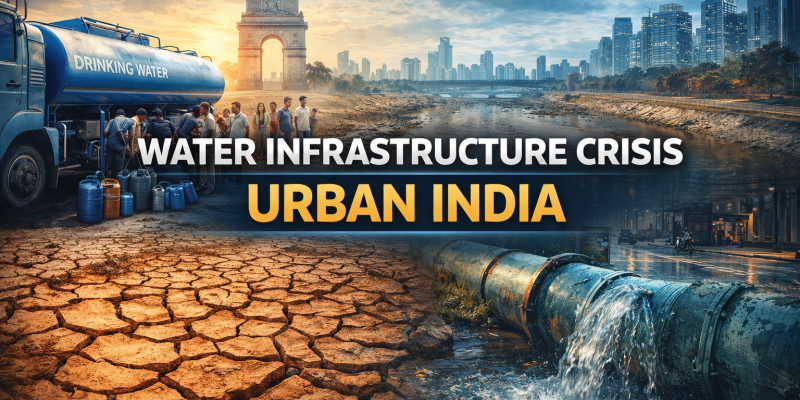
Water tankers have become a lifeline in many urban areas. Entire neighborhoods depend on privately supplied water, often at high costs.
This creates:
- Inequality in access to water
- Unregulated extraction of groundwater
- Increased financial burden on households
Water becomes not just a basic necessity, but a commodity controlled by access and affordability.
Pollution: Turning Supply into Liability
Even where water is available, quality is a growing concern.
Urban water bodies are increasingly polluted due to:
- Untreated sewage discharge
- Industrial waste
- Poor waste management systems
Rivers and lakes that once served as reliable water sources are now contaminated, reducing usable supply and increasing treatment costs.
Cities are not just running out of water. They are actively degrading what they have.
Climate Change: Making a Bad Situation Worse
Climate variability is intensifying the crisis.
Erratic monsoon patterns, prolonged dry spells, and extreme weather events are disrupting traditional water cycles.
Urban flooding during heavy rains coexists with water shortages during dry months. Infrastructure is failing at both extremes.
Because apparently, cities can now have too much water and not enough at the same time.
The Governance Challenge
Water management in India involves multiple agencies, fragmented responsibilities, and inconsistent policy implementation.
Key issues include:
- Lack of integrated urban water planning
- Weak enforcement of regulations
- Limited investment in infrastructure upgrades
- Poor data and monitoring systems
Without coordinated governance, even well-designed policies struggle to deliver results.
Potential Solutions: Moving Beyond Crisis Management
Solving the urban water crisis requires long-term structural changes rather than short-term fixes.
Infrastructure Modernization
Upgrading pipelines, reducing leakages, and improving distribution efficiency can significantly reduce water loss.
Rainwater Harvesting
Urban buildings and communities can capture and store rainwater, reducing dependence on external supply.
Wastewater Recycling
Treating and reusing wastewater for non-potable purposes can reduce pressure on freshwater resources.
Smart Water Management
Using sensors, data analytics, and IoT systems can improve monitoring and optimize water distribution.
Public Awareness and Conservation
Water conservation must become a collective responsibility, not just a policy directive.
The Bigger Picture
Water infrastructure is as critical as roads, electricity, and digital networks. Yet it often receives less attention until a crisis emerges.
Urban India’s growth story cannot be sustained without reliable and efficient water systems. Infrastructure investment, policy reform, and technological innovation must align to address this challenge.
Final Thought
The water crisis in urban India is not a future problem. It is already here.
Cities are expanding, populations are growing, and demand continues to rise. Without systemic changes, water shortages will become more frequent, more severe, and more unequal.
Because in the end, no matter how advanced a city becomes, it still runs on something very basic.
Water.
And when that runs out, everything else becomes irrelevant.