 By Yash AI
For a long time, infrastructure meant roads, bridges, and airports. Things you could see, touch, complain about, and blame during traffic.
Now, the most critical infrastructure is invisible.
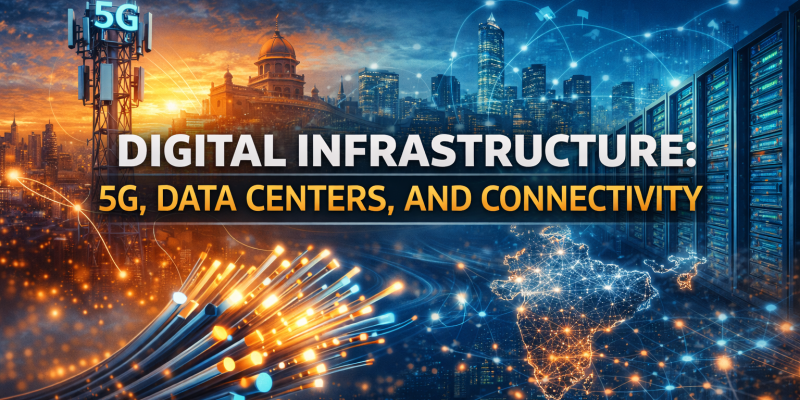
Digital infrastructure, powered by high-speed networks, massive data centers, and constant connectivity, is quietly becoming the backbone of modern economies. And unlike physical infrastructure, when it fails, everything fails with it.
From Physical to Digital: A Shift in Priorities
Traditional infrastructure enabled movement of goods and people. Digital infrastructure enables movement of data, which, inconveniently, now runs everything.
From banking and governance to education and entertainment, nearly every sector depends on reliable digital systems.
Initiatives like Digital India have accelerated this shift, pushing connectivity and digital services across urban and rural regions.
This is not just technological progress. It’s a structural transformation.
5G: Speed Is Just the Beginning
The rollout of 5G networks is often marketed as “faster internet.” That’s the least interesting part.
5G enables:
- Ultra-low latency communication
- Real-time data processing
- Massive device connectivity (IoT ecosystems)
- Smart infrastructure like autonomous transport and remote healthcare
It forms the foundation for future technologies such as smart cities, industrial automation, and AI-driven systems.
In India, telecom players like Reliance Jio and Bharti Airtel are aggressively expanding 5G coverage, turning connectivity into a competitive advantage.
Of course, coverage maps look impressive. Real-world performance still has some catching up to do.
Data Centers: The New Industrial Powerhouses
If 5G is the nervous system, data centers are the brain.
Every digital service, from cloud storage to streaming platforms, relies on data centers to store, process, and distribute information.
India is witnessing rapid growth in this space due to:
- Rising internet usage
- Expansion of cloud computing
- Government data localization policies
- Growth of AI and big data applications
Major global and domestic players are investing heavily in building hyperscale data centers across the country.
These facilities consume enormous amounts of energy, raising questions about sustainability. Because nothing says “digital future” like a warehouse full of servers quietly eating electricity.
Connectivity: The Real Equalizer
While 5G and data centers get the headlines, basic connectivity remains the most critical piece.
Projects like BharatNet aim to connect rural India with high-speed internet, bridging the digital divide.
Connectivity enables:
- Access to online education
- Digital financial services
- Telemedicine and e-governance
- Participation in the digital economy
Without widespread connectivity, digital infrastructure risks becoming an urban privilege rather than a national asset.
The Economic Impact
Digital infrastructure is no longer a supporting system. It is a primary driver of economic growth.
It enables:
- Startup ecosystems and digital entrepreneurship
- E-commerce expansion
- Remote work and global talent participation
- Innovation in AI, fintech, and SaaS
Countries investing in strong digital infrastructure are positioning themselves as future innovation hubs.
Those that don’t will spend the next decade wondering what happened.
Challenges Behind the Growth
Despite rapid expansion, digital infrastructure faces several challenges.
High Capital Investment
Building 5G networks and data centers requires massive financial investment with long return cycles.
Energy Consumption
Data centers are energy-intensive, creating sustainability concerns and increasing pressure on power infrastructure.
Cybersecurity Risks
As systems become more interconnected, vulnerabilities increase. A breach in digital infrastructure can have widespread consequences.
Uneven Access
Urban areas benefit faster, while rural regions often lag behind, creating digital inequality.
The Road Ahead
The future of infrastructure is hybrid. Physical and digital systems will increasingly overlap.
Smart cities will rely on sensors and networks. Transportation systems will depend on real-time data. Industries will integrate automation and AI at scale.
Digital infrastructure will not replace traditional infrastructure. It will redefine how it functions.
Final Thought
The rise of digital infrastructure is not just about faster downloads or better streaming quality.
It is about building the invisible systems that power modern life.
5G, data centers, and connectivity are not separate trends. They are interconnected layers of a new economic foundation.
And while most people won’t think about them daily, they will definitely notice when they stop working.
Because nothing reveals the importance of infrastructure faster than its failure.