

 By hodo_admin
Efficient public finance management is crucial for ensuring optimal utilization of government resources. One of India’s most transformative initiatives in this space is the Just-in-Time (JIT) funding system, a strategic reform aimed at enhancing fiscal discipline, reducing idle funds, and ensuring the timely availability of financial resources. This system has revolutionized fund disbursement across government schemes, leading to greater transparency and efficiency.
What is the Just-in-Time (JIT) Funding System?
The JIT funding system is designed to release funds precisely when required, aligning financial disbursements with actual expenditure. Instead of allocating lump-sum amounts in advance, funds are disbursed as per real-time requirements, ensuring better cash flow management and reducing financial mismanagement.
The JIT system is implemented through the Public Financial Management System (PFMS), a web-based application that facilitates real-time fund tracking and monitoring. This approach not only minimizes unspent balances but also ensures accountability in public spending.
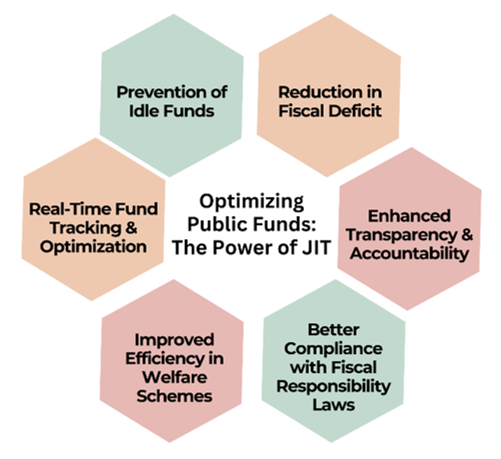
Key Features of the JIT System
The JIT funding system brings several unique advantages to public finance management, making it a cutting-edge approach for efficient fiscal governance:
- Prevention of Idle Funds:
- Traditionally, large sums of money remained parked in various bank accounts, leading to inefficient fund utilization.
- With JIT, funds are released only when needed, reducing unnecessary accumulation.
- Reduction in Fiscal Deficit:
- By ensuring optimal cash flow, the government minimizes borrowing costs and prevents excessive interest payments.
- Data from the Ministry of Finance indicates that JIT funding has contributed to a 15-20% reduction in unspent balances across schemes.
- Enhanced Transparency and Accountability:
- Real-time fund tracking through PFMS allows authorities to monitor expenditures efficiently.
- This system prevents fund leakages and misallocation, ensuring taxpayer money is utilized responsibly.
- Better Compliance with Fiscal Responsibility Laws:
- The JIT system aligns with the Fiscal Responsibility and Budget Management (FRBM) Act, promoting financial prudence.
- The government can maintain a better fiscal balance by ensuring that funds are available when required.
- Improved Efficiency in Welfare Schemes:
- Government programs such as MGNREGA, PM-KISAN, and the National Health Mission have seen significant improvements in fund utilization due to JIT implementation.
- Direct Benefit Transfer (DBT) linked with JIT ensures that welfare benefits reach the intended beneficiaries without delays.
Facts & Figures Supporting JIT Implementation
- Savings in Interest Costs: The adoption of JIT has led to savings of over ₹10,000 crore annually by reducing idle fund accumulations in various accounts.
- Faster Fund Utilization: A study by the Controller General of Accounts (CGA) reported that JIT-enabled schemes have 30% faster fund utilization rates compared to traditional funding methods.
- Enhanced Efficiency in Welfare Schemes: The system has minimized fund pilferage, ensuring 95% of funds reach intended beneficiaries without intermediaries. The Mahatma Gandhi National Rural Employment Guarantee Scheme (MGNREGS) adopted the JIT system in 2015, leveraging its real-time Management Information System (MIS). By 2016, over 60 million beneficiary accounts received timely payments, effectively eliminating delays.
- Adoption by State Governments: Following the central government’s lead, several state governments have embraced the JIT approach to enhance fiscal efficiency and reduce unnecessary borrowings.
JIT and Related Financial Reforms
- Integration with the Single Nodal Agency (SNA) System:
- The SNA system mandates routing all centrally sponsored scheme (CSS) funds through a designated nodal agency, ensuring better monitoring and fund flow regulation.
- The JIT mechanism works in tandem with SNA to eliminate fund fragmentation and duplication.
- Treasury Single Account (TSA) Implementation:
- The TSA consolidates government cash balances, enhancing liquidity management and ensuring seamless JIT disbursements.
- By centralizing government funds, the TSA system prevents inefficient fund parking across multiple accounts.
Conclusion
India’s Just-in-Time (JIT) funding system is a transformative shift in the financial management approach since 2021.By aligning financial disbursements with real-time needs, the government has significantly improved fiscal discipline, reduced wasteful expenditures, and enhanced the efficiency of public service delivery. As more digital innovations integrate with this system, JIT funding will continue to play a pivotal role in strengthening India’s economic framework and governance model.