 By Yash AI
High-speed rail is the kind of infrastructure that makes politicians smile for cameras and economists reach for spreadsheets. It promises speed, prestige, and progress. It also comes with billion-dollar price tags and decades-long timelines.
So the real question is simple. Are high-speed rail projects strategic national investments or very expensive vanity projects?
Let’s unpack the steel and the sentiment.
The Global Benchmark: Speed as Strategy
Countries like Japan pioneered high-speed rail with the Shinkansen, proving that trains could rival airplanes for short to medium distances.
China took it further, building the world’s largest high-speed rail network in just two decades. For China, it wasn’t vanity. It was economic integration at scale, connecting inland provinces to coastal growth hubs.
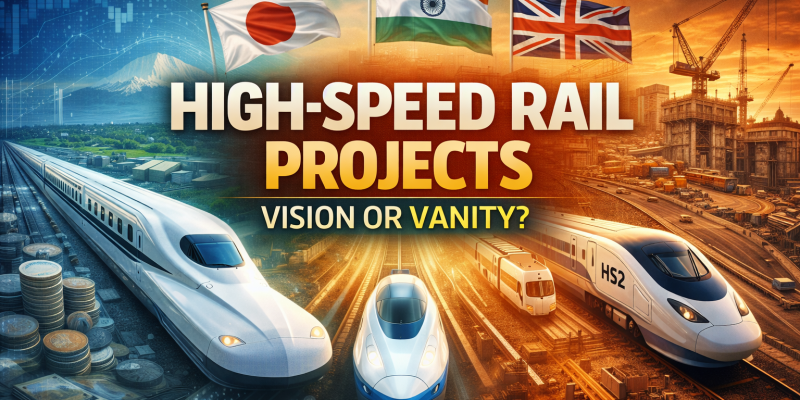
Meanwhile, projects like HS2 in the United Kingdom have faced cost overruns and political backlash, raising the inevitable question: is the prestige worth the price?
India’s Bullet Train Moment
India’s flagship high-speed rail project, the Mumbai-Ahmedabad High-Speed Rail, backed by Japanese collaboration, aims to cut travel time drastically between two major economic centers.
Supporters argue:
- It boosts long-term productivity
- It stimulates regional development
- It transfers advanced technology
- It creates jobs and supply chains
Critics argue:
- Costs exceed initial estimates
- Land acquisition delays inflate budgets
- Ticket pricing may exclude lower-income passengers
- Existing rail infrastructure still needs modernization
In a country where basic rail safety and capacity upgrades are ongoing priorities, skeptics see the bullet train as aspirational excess.
The Economics: Multiplier or Mirage?
High-speed rail can:
- Increase property values near stations
- Create transit-oriented development
- Reduce air traffic congestion
- Lower carbon emissions over time
But the break-even period is long. Very long.
These projects often require:
- Heavy public subsidies
- Decades before full returns
- Political stability across multiple administrations
If projected passenger volumes fall short, the economics collapse quickly.
Infrastructure does not forgive optimistic forecasting.
Climate Argument: Green or Just Faster?
Rail is generally more energy-efficient than air travel for medium distances. Electrified high-speed trains can reduce per-passenger emissions, especially when powered by renewable energy.
However, construction itself has a massive carbon footprint. Steel, concrete, land clearing, and energy-intensive engineering raise environmental concerns in the short term.
So the climate argument depends on long-term usage and energy sourcing.
Political Optics vs Structural Reform
Let’s be honest. High-speed rail is visually impressive. It symbolizes modernity.
Governments often use such mega-projects to signal ambition and global competitiveness. It is infrastructure as narrative.
But prestige projects should not crowd out:
- Basic rail safety upgrades
- Rural connectivity
- Affordable commuter transport
- Freight corridor expansion
If the foundation is weak, speed becomes cosmetic.
Urban Transformation Potential
When executed well, high-speed rail reshapes urban geography.
It can:
- Turn secondary cities into economic magnets
- Reduce pressure on megacities
- Encourage regional decentralization
China leveraged this effect aggressively. Japan perfected it. The UK is still debating it.
India now stands at a crossroads.
Vision or Vanity?
The answer is not binary.
High-speed rail becomes vision when:
- It integrates with broader infrastructure planning
- It is financially structured responsibly
- It serves real mobility demand
- It complements existing systems
It becomes vanity when:
- It is politically rushed
- It lacks long-term funding clarity
- It ignores grassroots infrastructure needs
Infrastructure is not about speed alone. It is about alignment with national priorities.
The Bigger Question
Every nation must decide what kind of future it is building.
Is high-speed rail about national pride? Economic integration? Climate strategy? Or global signaling?
In reality, it is usually a mix of all four.
The steel tracks may carry trains at 300 km/h, but the real journey is about whether infrastructure choices reflect structural reform or symbolic ambition.
Because in the end, speed is impressive.
Sustainability is transformative.