 By hodo_admin
Tracking the Use of Caste, Religion, and Demographics in Campaign Algorithms
Elections have always been about identity. Caste, religion, language, region, and class have shaped political mobilisation in India since independence. What has changed is not whether identity matters—but how it is identified, analysed, and acted upon.
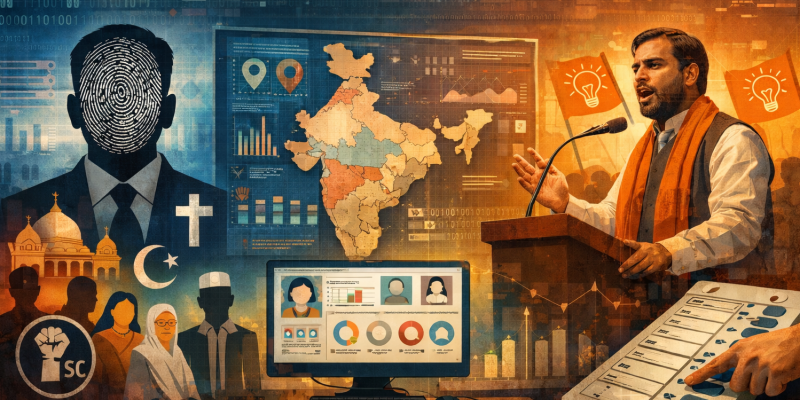
Today, electoral politics is increasingly mediated by data systems and algorithms. Campaigns no longer rely only on public rallies, caste leaders, or visible vote blocs. Instead, they also use digital signals, demographic inference, and behavioural patterns to understand voters at an individual or micro-group level.
This article examines how caste, religion, and demographic identity are being incorporated into modern campaign algorithms, what this means for political strategy, and the democratic questions it raises.
From Social Mapping to Data Modelling
Traditional election strategy relied heavily on social mapping. Parties maintained booth-level knowledge through local workers who understood caste composition, religious balance, and community influence. This knowledge was qualitative, uneven, and dependent on human networks.
Digital campaigning has introduced a different approach: identity modelling.
Campaign systems now combine multiple data sources:
- Voter rolls and booth-level turnout history
- Welfare scheme beneficiary databases
- Census and socio-economic indicators
- Social media behaviour and language use
- Grievance portals and service-delivery feedback
From this, algorithms infer identity markers—not always explicitly, but probabilistically. Surnames, location, occupation, language preference, and consumption patterns are used to estimate caste or community affiliation with varying degrees of confidence.
Identity is no longer just observed. It is calculated.
How Campaign Algorithms Use Identity
Modern campaign algorithms do not treat caste or religion as standalone variables. Instead, they integrate identity with behaviour.
A simplified model might ask:
- Is this voter from a historically marginalised community?
- Do they engage with political content?
- Have they benefited from welfare schemes?
- Do they express grievance or satisfaction?
- Are they persuadable or firmly aligned?
Based on this, voters are categorised into functional groups such as:
- Core supporters
- Soft supporters
- Swing voters
- Disengaged voters
- High-grievance voters
Caste or religion influences how messages are framed, not whether they are sent. A welfare message may highlight dignity and inclusion for one group, economic stability for another, and aspirational mobility for a third—while referring to the same policy.
The algorithm does not “care” about identity in a moral sense. It optimises for response.
Demographics as Predictive Signals
Beyond caste and religion, demographic variables play an increasing role in campaign decision-making.
- Age affects platform choice.
- Gender influences issue prioritisation.
- Urban or rural location shapes narrative framing.
- Education level correlates with message complexity.
Campaign systems test multiple versions of the same message across demographic segments and amplify the versions that perform best. Over time, this creates feedback loops where certain identities consistently receive specific narratives.
This is not persuasion in the traditional sense. It is adaptive messaging.
Welfare Data and Identity Reinforcement
One of the most powerful inputs into campaign algorithms is welfare data.
Welfare databases reveal:
- Who has been reached by the state
- Who has been excluded
- Who experienced delays or errors
- Who repeatedly interacts with the system
When combined with demographic identity, this data allows campaigns to reinforce or repair political relationships.
What Has Changed—and What Hasn’t
It is important to note what algorithms have not changed. Caste and religion have not disappeared from politics. Identity-based mobilisation has not ended and social hierarchies have not been flattened by technology.
What has changed is scale, speed, and invisibility.
Earlier, identity politics was public and contestable. Today, it is often private, personalised, and difficult to observe from the outside. Different voters may receive different political realities without ever knowing it.
Democratic Risks and Open Questions
The algorithmic use of identity raises several unresolved questions:
- Transparency: Voters rarely know why they are receiving specific messages or what data was used to target them.
- Consent: Most identity inference happens without explicit permission.
- Fragmentation: When groups receive tailored narratives, shared public discourse weakens.
- Manipulation: At what point does targeted messaging cross from representation into psychological exploitation?
These are not questions of technology alone. They are questions of governance and democratic norms.
The Regulatory Gap
India currently lacks a clear framework governing the use of demographic and identity data in political campaigning. Election laws focus on expenditure, silence periods, and overt advertising—not algorithmic targeting or AI-driven persuasion.
This gap does not stop innovation. It simply shifts power toward those with greater data access, technical capacity, and resources.
Looking Ahead
Campaign algorithms will continue to evolve. They will become better at predicting preferences, optimising messages, and responding in real time. The critical question is not whether caste, religion, and demographics will be used in these systems—they already are.
The real question is how openly, how fairly, and to what end.
Will data-driven politics deepen democratic responsiveness, or will it turn identity into a variable to be endlessly optimised? The answer will shape not just future elections, but the nature of political representation itself.